
Which Sacrifice Does God Prefer?
Did modern Catholics stop offering God their best?

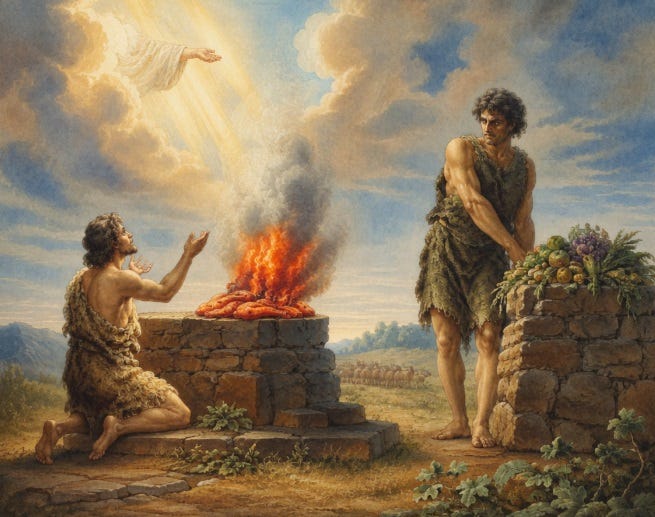
An interesting comparison has made the rounds in Trad circles for a while now: The Traditional Latin Mass is like the sacrifice of Abel. The Novus Ordo is like the sacrifice of Cain.
I’m sure that when people hear this, it sounds ridiculous. “Surely the matter can’t be that simple. Surely millions of Catholics attending their local parish aren’t like Cain, while those attending the old Mass are like Abel. That’s an unfair comparison!” Yet the fact that it continues to appear in Trad Catholic writing suggests that it touches something deeper than just an insult. I think that a comparison like this survives is because it points to something true. Love it or hate it, the fact that this comparison appears repeatedly in Trad conversations tells us that it’s worth a look.
A Culture of Sacrifice
So, okay. The modern world has forgotten about this idea of sacrifice. But the ancients lived in a sacrificial world. Modern man imagines religion as a matter of abstract ideas. One believes certain propositions about God, attends services from time to time, and attempts to be a reasonably decent person.
The ancient world, however, thought differently. For them, religion is supposed to be an act of worship. It was an action. You’re not just someone with an ideology, and you’re “rooting for a team.” The question wasn’t merely what one believed, but what one offered. A verb is involved here. Across the ancient world rose temples, shrines, sacred groves, altars, and holy places. To these places, men brought grain, wine, incense, lambs, oxen, and doves. Some societies even sacrificed human beings—perhaps their own family or neighbors. Whatever their errors, ancient peoples understood that approaching the divine required an offering.
The entire history of mankind after Eden is a history of sacrifice. The first thing we find after the expulsion from Paradise isn’t a story about merchants. We’re not learning about Hammurabi. We’re not told about the establishment of commerce, politics, or philosophy. That’s all from secular history books. But as far as our Faith is concerned, we see that our first post-Eden story is about worship and sacrifice. Two brothers approach God. They bring offerings, and one of them is accepted while the other is not.
The story is so familiar that we have failed to appreciate how foundational it really is. Consider that before there was ever an Israel or a Jerusalem, a Temple—or even a priesthood of Aaron—we had this extremely basic, primordial story of two men standing before God with offerings in their hands.
Cain and Abel
Scripture tells us that Abel offered the firstlings of his flock and the fat portions thereof. Cain offered the fruits of the earth. Now, for centuries, Christians wrestled with why one sacrifice was accepted while the other was rejected. The Fathers and commentators generally understood the distinction not as one of material, but of disposition. Abel offered his best. Cain offered something less. Abel approached God in humility, but Cain approached God with lackluster effort. Abel gave God the first and the finest, but Cain only fulfilled an obligation.
Worship is not merely about showing up and checking a box. Right worship concerns what place God occupies with our priorities. Do we offer Him our best? Do we just give Him our leftovers? The story of Cain and Abel asks a question that remains as uncomfortable today as it was thousands of years ago: What kind of offering does God deserve?
Modern people dislike these questions. We live in an era that distrusts excellence because excellence implies “hierarchy.” If one thing is better, then another thing is worse. If one offering is greater, then another offering is “less-than-stellar.” Modern minds hate these distinctions. People will whine: “Sincerity is all that matters! God does not care about externals. Intention alone is sufficient!”
Scripture Challenges “This Is Good Enough” Assumptions.
When God instructed Moses concerning the Tabernacle, He specified dimensions, materials, vestments, colors, furnishings, and rituals in great detail. When Solomon built the Temple, the structure was adorned with meticulous beauty. Gold-covered walls and precious materials were everywhere. Worshipping God wasn’t casual or ordinary—it was an act worthy of mankind’s highest efforts.
One will struggle to find examples in Scripture where worship ever becomes simpler, plainer, less reverent, or less formal. The movement of all of this is always in the opposite direction. Worship grows more elaborate the more that men recognize God’s majesty.
Modern Liturgical Debate
Some Trad Catholics will argue that the Traditional Latin Mass represents the accumulated wisdom of centuries. They’ll say it wasn’t the creation of a modern committee, or even that it was assembled by lettered experts over the course of a few years. Rather, it developed organically through generations of saints, bishops, priests, monks, and faithful Catholics. Furthermore, there are others who point out that, more than anything, the very core of the Mass—the Canon, the essential structure of the liturgy of word and sacrifice—reaches back to the earliest centuries.
Then came the twentieth century.
Liturgical reform that followed the Second Vatican Council introduced changes on an unprecedented scale. Languages, calendars, prayers, ceremonies, music, orientation—even the architecture—all of that was transformed from its classical form. The old liturgical world, which had been recognizable for centuries, was pushed aside for something novel.
The defenders of these reforms viewed them as necessary adaptations. In their writings, you’ll read how they believed modern man “required a liturgy more accessible to contemporary sensibilities.” Traditional Catholics, however, saw an inheritance being dismantled. The Faith of their fathers was treasure that should have been protected—only now, it was a treasure being renovated according to modern tastes.
“Novus Ordo” Cain, “Traditionalist” Abel
One traditionalist compares the Traditional Latin Mass to Abel’s sacrifice and the Novus Ordo to Cain’s. Another argues that modern Catholics had ceased offering God their best—that they instead offer Him something fashioned according to their own eccentric preferences. Precise details vary from person to person, but the idea remains the same. Abel receives a gift from God and returns it with gratitude. Cain presents something of his own choosing. Abel conforms himself to the Divine. Cain expects the Divine to accommodate him.
Whether that analogy is fair is a separate question. What interests me more is why Trads find it persuasive. Honestly, I suspect the answer lies not in liturgical rubrics but in a broader cultural pattern. Hear me out on this.
For generations now, Western civilization has been engaged in a project of simplification. Churches are less ornate and more like barns. Language, manners and dress became less formal. Music became less sophisticated and more banal. Education isn’t rigorous anymore. Family structures are less stable. We traded excellence for accessibility. We traded down.
Everything was to be made easier, simpler, and more comfortable—such that we’re now trapped in a wasteland of pastels.
The liturgical revolution occurred amidst this broader cultural movement. So, many Trads now perceive the new liturgy not merely as a change in worship, but as one, great big expression of a larger discivilizational trend. Really, for Trads, the question isn’t simply “Latin versus English.” It’s not incense versus guitars, or ad orientem versus facing the people. The question for Trads is whether modern man still believes God deserves mankind’s highest offering.
That’s what’s at the heart of this Cain and Abel analogy.
The comparison isn’t always about the validity of the Novus Ordo. And I’m not talking about the holiness of individual Catholics. There are undoubtedly devout souls worshipping in ordinary parish churches throughout the world. And there are undoubtedly priests offering the Novus Ordo with deep reverence and sincere love for God. To deny this would be foolish.
Qualifiers aside, though, this analogy asks a more uncomfortable question: What kind of gift are we attempting to place upon the altar? Are we offering God something received humbly from generations past? Or are we offering Him some redesigned, slap-dash thing that’s fashioned off our own fads? Are we approaching worship with the mindset of stewards, or are we just trying to make everything convenient for ourselves? Are we preserving a sacred inheritance or endlessly remodeling it into some sort of ramshackle circus parade?
It really is a debate refusing to die.
Conclusion
For decades Catholics were told that liturgical controversies would fade away and “that old Mass would disappear.” Young people would move on. But we all now see that the opposite has occurred. Young Catholics with no memory of a Pre-Conciliar Church continue to discover the ancient liturgy—and they continue to travel long distances to attend it. They fill Traditional seminaries, schools, chapels, and communities.
They aren’t doing this out of nostalgia. They’re too young to be nostalgic for this. What they are doing is the same thing that Abel did. Like him, they seek to offer the very best of themselves and the very best Mass they can attend. They’re not trying to be fashionable and relevant. They are doing their best to offer the best prayer that they can.
Every generation has to decide what sort of sacrifice it wishes to offer. Does worship exists primarily to satisfy man? Or is it there to glorify God? This is one of the lessons we can take from “Cain and Abel.”
Traditionalists instinctually believe that the Mass of the Ages best resembles Abel's sacrifice. Whether they are right or wrong about that comparison, the deeper question remains: Do each of us resemble Abel at all? Do we offer God the first and the finest, or merely the leftovers after we’ve satisfied ourselves? That question haunted Cain until he murdered his brother. It haunts modern man now. And it’s a question that won’t disappear simply because we stop asking it.
Long ago in the early 1990's I was working for a financial company in Boston. At the time some of the big firms had introduced "casual Fridays" but not our firm. During the weekly meeting at the beginning of the summer someone asked the CEO if we were going to have casual Fridays. The CEO was a man in his mid sixties, a former Marine officer who had raised that company from nothing into a regional powerhouse. His answer was as spartan as they come: "Casual dress, casual work. No one is going to give tens of millions in investments to a young man who does not bother to wear a necktie. This company will not have casual days." I think the same regarding Church although I have been known to dress "casual" many times. Now that you made me think about it: if I am going to visit the house of my Creator, the One that sustains the whole Universe... better dress up and be well groomed.
Cain's "I will not serve" resentment of Abel's proper sacrifice to God is related to Consiliar Catholic resentment of trad Catholics' Tridentine Mass.
And technically speaking, the true proper sacrifice is adherence to St. Pope Pius V's "Quo Primum" Liturgy.