
Impressions After Returning from the Philippines
A debriefing and rambling dispatch

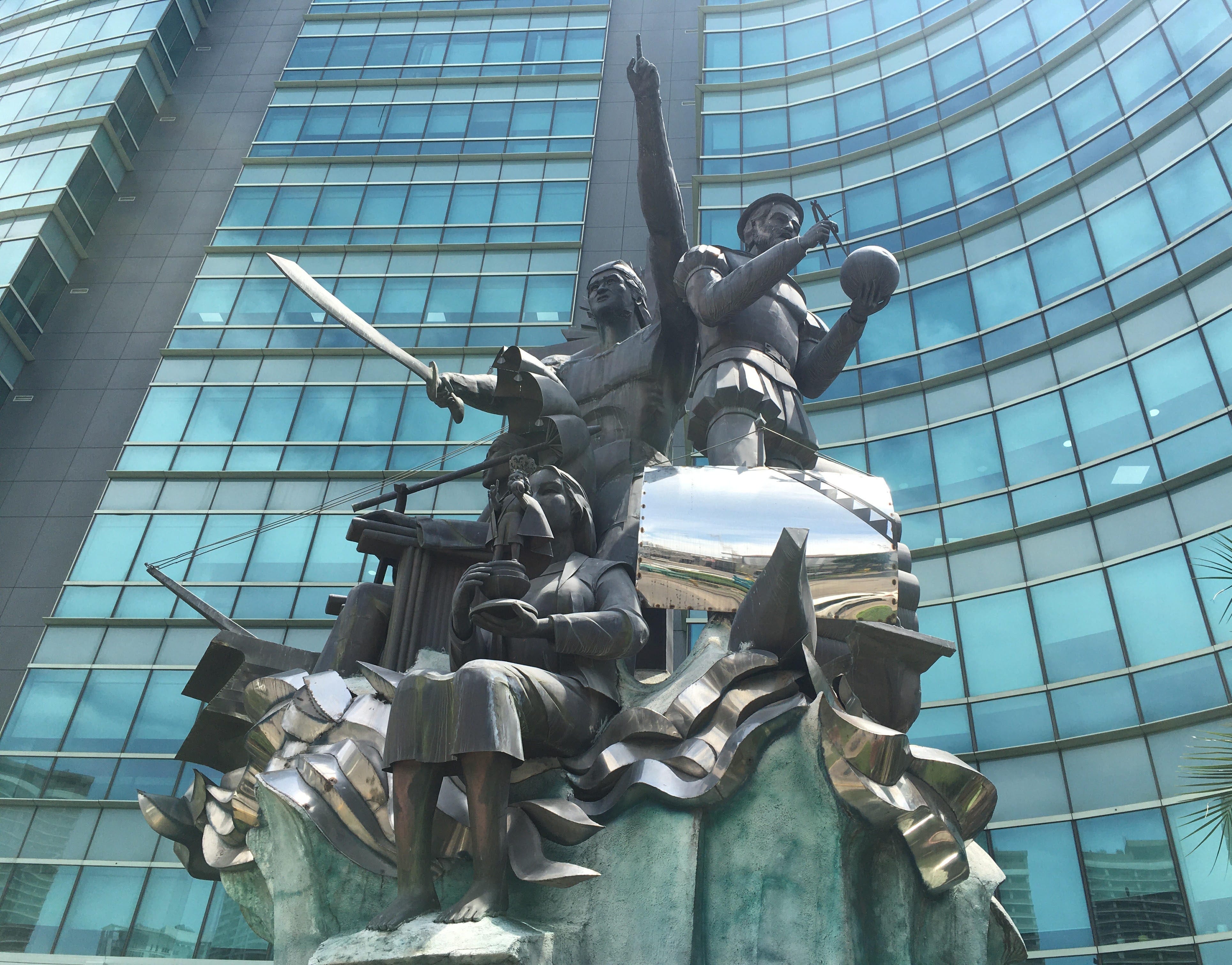
I know that I’ve been talkin’ to y’all there and there about this long Philippine sojourn I just returned from. And I suppose I ought to tell you some of my takeaways from it now, while the iron is hot.
Well, it’s been 15 years since I was last in Cebu—the home of the Santo Niño. And there, I saw some notable changes.
A People Still Themselves
The Filipino people have a special place in my heart. They are good, decent, family people. Loving and gentle. And again, this is why I feel Christ came to them as a Child (see my last article about the Santo Niño miracles)—because they are a nurturing and good folk.
Furthermore, I am happy to say the Filipinos—the Cebuanos, at least—seem to be able to continue holding onto who they are. They are secure in their identity. What I mean to say is this: after all of the masses that I attended there, the priest led the congregation in prayer to God for help for the Filipino people and the Filipino nation. And there were prayers to God to root out national corruption.
Can you, my fellow Americans, imagine such a prayer for your people at the end of a mass in your own towns? Can you imagine a prayer to God for help to preserve the American people and to strengthen the nation? Critics would complain that this is “tribalism,” and antithetical to the stewpot, multi-culti, Kalergi Plan march to erase your Western identities. And yet, the Filipinos have no problem with defending themselves amidst 21st century challenges. They have no shame, no hesitation, no reason to be given pause. It was one of the most admirable things I saw.
I do not know how widespread such prayers are throughout the country, but I found it refreshing—particularly, given that the Philippines are a trade nexus, through which pass so many other peoples.
Oh, and speaking of prayers at the end of a Filipino mass—I was particularly moved when I saw how all of the children of the parish were called up to the priest in the front, and the entire congregation prayed for them before everything concluded. Again, this is a family-oriented people. They love their children. I can’t repeat this enough.
Signs of Material Progress
I’m happy to report that the buses, from what I saw, were no longer dangerously charging along the coastline roads to a frightening degree. Though, drivers still manage to create their own “third lane” on these two-lane roads, which is unsettling to the American driver.
I was also pleased to see that, in spite of the conflict with the Strait of Hormuz choking up all of the supply—and the Philippines being so dependent upon that source of fuel—I nevertheless saw bustling commerce in the shops and markets. And, in fact, there were so many people at the malls, that I downright felt claustrophobic from the utter intensity of so many. (I was very relieved to return to the much less densely populated American city of my birth after this trip.)
I also saw more development since my last visit 15 years ago. I view this sort of thing as a good. A people really should progress, have more convenience, city planning, and more options. The Left views this as modern, consumerist corruption that opposes the “natural way of things.” But the fostering of human growth and flourishing is a good that God has ordained for all men. The Creator knew that we would be accessing all of the soil, air, fuel, and resources one day. It is there for our use. I am glad when I see modern development, as it’s conducive to the ongoing march toward one day populating Heaven, itself. The “overpopulation” nannies can stick it.
Ominous Things
The world is changing and turning into a difficult situation. And while a lot of people are doing their best to escape to other countries, this crisis is global, and everyone is feeling the problems—both man-caused as well as nature-caused.
In terms of the latter, the locals have noticed that the weather seasons are delayed. Let me explain. In the Philippines, there are two seasons: the hot season and the rainy season. Now, the locals there have told me they feel the seasons are less dependable than they used to be. The hot season is lasting longer, and the rains of the rainy season are more irregular. Locals told me that weather is harder to anticipate.
La Niña is another concern. It can shift tropical-cyclone formation and storm tracks farther west, increasing the likelihood that the Philippines will experience more direct impacts or prolonged rainfall. Storms may also remain a threat later in the year than people expect.
And then there are the latest spate of volcanic eruptions and earthquakes. On that point, you can listen to either Stefan Burns or the man running Suspicious Observers, where you can hear discussions about the link between increased solar activity and the latest geological crisis. I swear, every time I hear about a crazy CME coming off the sun, some new seismic thing is happening in the Philippines.
The Human Tide
As for the human element, it certainly seemed to me that there were more people. Cebu City is more congested and dirtier than ever. It felt like traffic doubled in intensity from 15 years ago, but statistics show that the population only increased by approximately 100,000 people. I think the visible urban footprint has intensified in that city, what with the traffic and construction. The wider metro Cebu area has also been filled in with more people.
The use of motorcycles (“habal-habal”) is more prevalent at this time than ever. And I also think the city is trying to do away with the classical jeepney and go more toward a more modern shuttle bus for public transport. All of the new traffic has, of course, increased pollution levels. Several of us had itchy eyes and sore throats, and it seemed we had to take allergy meds every few days.
One thing that shocked me was the new sprawl across the island. Every time we go to the Philippines, we mostly stay on Cebu, and we’ll traverse both the northern and the southern ends of it. Fifteen years ago, we’d take the southern road and round the island for a view of the southern tip of Negros Island. When we’ve taken that road in the past, once you went by the town of Oslob, the road was empty and free. You’d mostly only see wilderness. But on this visit, all the way around the southern part of Cebu Island, the road was lined almost all the way with shanties and newly-constructed little buildings. And this made me a bit sad, as that day, I was looking forward to a rural escape from the city population center. But no, there were still people everywhere down there.
I saw the same sort of sprawl—perhaps to a lesser degree, when we went north to the port town of San Remigio. There’s even people moving out, up into the island’s mountains.
Speaking of the movement of people in this country, locals tell me that many from the large, Muslim-populated island of Mindanao have been moving up into Cebu Island. This, according to what I hear, is due to various fights and conflicts between groups there. And so, we’ve seen more than our usual share of Muslims on the Catholic island of Cebu. This worries me for my fellow Catholics there.
I’ve also been told that these migrants cause problems. And native Cebuano residents will appeal to authorities in order to deal with them. Nonetheless, their interregional migration to Cebu remains unimpeded.
I was at Bantayan, and a fellow who looked quite different from the Cebuanos was in the area near me. His face seemed longer. I was told this was one of the people moving up from Mindanao. He was just standing around, beating a drum. I felt a little bad for the guy and gave him a handful of single peso coins from my pocket. My friend told me I shouldn’t have done that. He was proven right immediately later, because the Mindanao beggar called up his friend shortly after, and then there were two. After that, local cops drove the two away. The island has an interest in protecting their tourism. But still, the episode sticks in my mind.
One More Note About Development
Usually when we visit, there is a particular fishing village out on a tiny island we go to. Very remote and off the beaten path. I don’t think many tourists go here. To get there, you’ve gotta travel by van or bus to a port, take a ferry to another island, then hop on a tiny pump boat and cross the sea for thirty minutes.
Once there, you’ll see that the island is hot and dirty with no running water. In fact, drinking and bathing water is brought in by jugs. That said, it looks like the tiny village has recently acquired electrical lines, and there’s a new concrete walkway going through the center of the village. Finally. Thank God those people are getting these things.
I’m sure the folk there have been on that island for centuries, and it frustrates me that development is so gradual. There’s a real lifestyle disparity between that island and Cebu, but such is the case for many rural locations throughout the world. But to be sure, their remoteness also protects them. Those families living on that tiny island are rooted in their community in a way most of us will never understand.
TradCath Observations: Catholics Under Pressure
Latin Mass was still relegated to the small, insulated communities. Sadly, I don’t think that we’ll be seeing a TLM at The Santo Niño Basilica anytime soon.
I picked up a parish newspaper and read this: Archbishop Marcel Lefebvre and the SSPX. It was conventional, post-conciliar, diocesan-level anti-SSPX attacks, warning ordinary Catholics away from the Society and its tangential movement. “The Church has spoken; Lefebvre disobeyed; therefore the SSPX is schismatic” is the basic gist of the article. My takeaway: just as American priests feel they now have a mandate for attacking the flock for being too Catholic, the same is happening in the Philippines. It was just another establishment-oriented, polemical warning tract.
Oh, and the whole country is on board for celebrating gay pride. And I saw crossdressers more than once. I guess it’s a Southeast Asian thing, even in a Catholic country such as this.
Speaking of infiltration, somewhere on the road beyond Carcar, we passed a great red Masonic obelisk planted beside the mountain road. It was a startling monument to encounter on an overwhelmingly Catholic island. But make no mistake, the Freemasons have a foothold in the Philippines as well.
And speaking of Freemasons, I encountered two Protestant “missionaries.” These opportunistic scavengers, rather than head on out to Saudi Arabia to lay down their lives to convert Muslims, would rather pick off the weak in a Catholic country. But what I found interesting was their schedule. They only went from place to place, staying only a day at each place. What can you get done with such brevity?
There were two of these jackals. One was a young twentysomething, and it was his first time in the country. He was willing to chat, but quiet and nervous about socializing. I got the feeling he was instructed not to talk to anyone. The older one who was grooming him for this task was a man in his sixties who’d been in the country 15 times before. I tried talking about various tourist sites and places of interest, but the man had never been anywhere that was “off mission.” I tried talking to the guy about diving with whale sharks, canyoneering, or the malls—but he had no clue about any of it.
In fact, these missionaries, from what I gather, show up in the country, travel to their destination, do some sort of token appearance for a day, and then move on to the next location, never rooting themselves with any of the people. What a complete waste of resources. I’m not even sure these guys knew anything about ube dessert—which is a very common confection you can try over there.
To put it another way, I’m getting the feeling that these “missionaries” are doing nothing more than setting up franchises simply to claim real estate, much the same way McDonald’s is more of a real estate corporation than a restaurant business. Just my opinion, but if these people want to impress anyone, maybe they should start picking up litter. Maybe that would make an actual impression and root them to a community.
Other Observations
In spite of the growth of the human population, there are still critters a-plenty. Large floor-wandering huntsman spiders the size of your toddler’s hand and big brown snails the size of your toddler’s fist are still crawling outside of the home. And at night, the tuko lizard will chat away while you fall asleep. There is no shortage of mosquitoes, and sudden isolated showers likely help with that problem.
There were mangoes a-plenty this visit, as well as their delicious breed of local bananas. But I was pretty sad that there was no jackfruit to be found anywhere. And believe me, I looked.
And I was reminded once more that, whilst thinking I’d get an air conditioning break by visiting the malls, in reality, they aren’t too air conditioned.
TV commercials were positive and upbeat, often featuring happy children as a target audience. I felt like it was the 1980s again with all of these kid-friendly commercials. The stark contrast between the family-oriented media of the Philippines against the anti-family, self-indulgent, childless culture of America was in my face.
In regards to volcanoes, as I said last month, we were treated to a small rain of volcanic ash on the city. It smelled sort of like an earthy ashtray. Though, were I to be more precise, it smelled like a mix of freshly lit lomboy cigarillos (their local smokes) and an ashtray.
Cockfighting: it’s still a thing here. We went to one fella’s house out in the province, and he had several dozen on his property, including special cages where he bred his best fighters. My son was amazed, and he said to me: “So, Dad, collecting fighting roosters for him is sort of like collecting Pokémon?” I said “Yes. That’s exactly what this is.” Except gambling is involved, too.
Musical Realizations
As I mentioned in past articles as well as this one: domestic life and the children are important to the Filipinos. They truly care about their young.
This hits me right in the heart when I hear two pieces of music. I’ve always known these songs, but now that I realize that the care for their children is THE defining characteristic of these people, I’m all-the-more astounded.
The first song is Bato Balani sa Gugma. While it’s a devotional hymn from 1788, it really sounds more like a lullaby for children than anything. This is not a slight in the least. I feel that this hymn continues to show the Filipino deference toward children (in this case, the Child Jesus). While listening to a woman sing it, the song sounds like a sweet mother singing to her baby. Hearing an entire congregation sing this during a mass is stirring in many different ways.
The second song that struck me on this trip was Freddie Aguilar’s Anak. This song is extremely Filipino, through and through. But to take it to the next level, just read the translation of the lyrics, and you’ll once more see that affection and love for their children that God always knew was their strength.
The day you were born to this world
Your parents were full of joy
And their arms are your lightAnd your mother and father
Worry and don’t know what to do
Watch over you even in your sleepAnd in the night, a sleepless night, your mother
Is still awake to prepare your milk
Click on the LINK I’m again providing to hear this one. I think you’ll agree with me about this.
Concluding Thoughts
My biggest realization came once I got home this week.
We needed to restock our pantry, having been gone so long. So I had to do a Walmart run. Grateful that I remembered how to drive, as I ambled down the road to the store, I actually got emotional. The air was clean. It was hot outside, but I was air conditioned in my van. There is space absolutely everywhere. The traffic was orderly.
I remember fifteen years ago in the Philippines, there was a big ditch near where I was staying. And in that ditch was piles and piles of garbage. It looked like a mini-dump. I just wanted to rent a truck and start picking it all up. It was next to a small community stream that emptied out elsewhere.
This year, I walked by that same ditch. The dump was gone, and in its place, on those steep edges going down to the stream were little shanties. Ramshackle hovels, built out of whatever wood, sheet metal, and canvas they could find. To make some money, the ladies often sold chicken and treats. I remember seein’ some kid going to the bathroom in a bucket outside for all to see.
Usually, I like a good rain. But there, in that tiny place next to the neighborhood creek, torrential rains could be a fatal disaster for the people living in those shanties.
All this, I thought of a few days ago, as I drove through my spacious town. I got out of the car, went into Walmart, and the air was clean and cool. I hadn’t breathed such purified air for more than a month. The vegetables were tidy and neat. The store clean. The lights bright. We were not shoulder to shoulder. There was so much meat. So much dairy. So many choices on the shelves. I know I’m sounding like a charity infomercial, but I’m not going to lie. I got emotional. I thanked God for what we have.
I remember showering a couple of days ago. My first American shower since being back. There was water pressure. The water was hot. I wasn’t using a bucket of cold water. The cool water wasn’t dribbling out of a plastic faucet. It was forcefully hitting me, liter after liter of hot water. I felt so guilty for wasting so much water.
Here in America, we really have a high standard of living. Thank You, God, for this time of plenty that we’ve had. I’m shell-shocked by culture shock. No matter how long I ramble on, or what language I use, nothing will be able to convey to you what I’ve seen, experienced, and felt.
I suppose it’s like this for a lot of folks who travel abroad.
I’m so wrung out, overwhelmed, and disoriented. I’ve had a lot of conversation with God through all this. He sure is overseeing a lot with this world. His might continues to be unimaginable to me. God has made all of this big, wide world possible. Once you see how big it can be, I’m sure you’ll be just as stunned.
A personal note…
Our return home was not an easy one. We were greeted by several unexpected household problems and expenses, all of which arrived at once and made the homecoming rather more difficult than I had anticipated.
So, if you found this travel report worthwhile—and if you would like to help us get back on our feet after the trip—I would be very grateful for any paid subscription, gift subscription, or one-time contribution. Every bit helps.
And, as always, thank you for reading and supporting The Weltgeist.
The idea of protestants aspiring to be pretend franchise owners to “claim” land for freemasons is very interesting.
Also noticing that people use institutional corruption as a “mandate” to assault Catholics is very smart. Bravo. I noticed it almost immediately once I started interfacing with Catholics again in 2015 that Priests by and large HATE Catholics, because Catholics know what they are doing is wrong or when they say something blasphemous or heretical.
Therefore the constant fixation on a revolving door of “Converts” and “”reverts”” (I hate that word, even non-Catholics are using it now) because they can’t tell when someone is messing up or worse.
Similarly, point out that Parents are unforgivable damned with any of their undecided/undisowned Children, and therefore so are Priests are with ANYONE in their Parish that they have not rebuked the sin of, and then the circus starts. Of course, it DOES explain the neurotic nihilism so many Clergymen have, as if they feel they have to be “powerful in hell” if they are going there anyways.
Not a pleasant thought.
What isn’t mentioned though is that Laymen are also filled with this same angst against Catholics, and so join in on the struggle session: ESPECIALLY if it’s one of the “I just Converted 5 minutes ago, now I’m a ‘Catholic influencer.’” types.
Basically no one with one foot in hell likes anyone with the Knowledge to Convict and the Conviction to Expose them.
Thank you for sharing your immersive trip to the Philippines. I am anticipating a trip to SE Asia myself. In looking up if I have to wary of cooked dog where I am going (not in the city I will visit but elsewhere in the country yes). In tooling around the web searching on this, I found that poor people in the Philippines make a dish from chicken salvaged from restaurant dumpsters. It's called Papag. The wretched lot of some many on this earth.