
After Christ’s Resurrection, When the Dead Rose and Testified
From The Gospel of Nicodemus

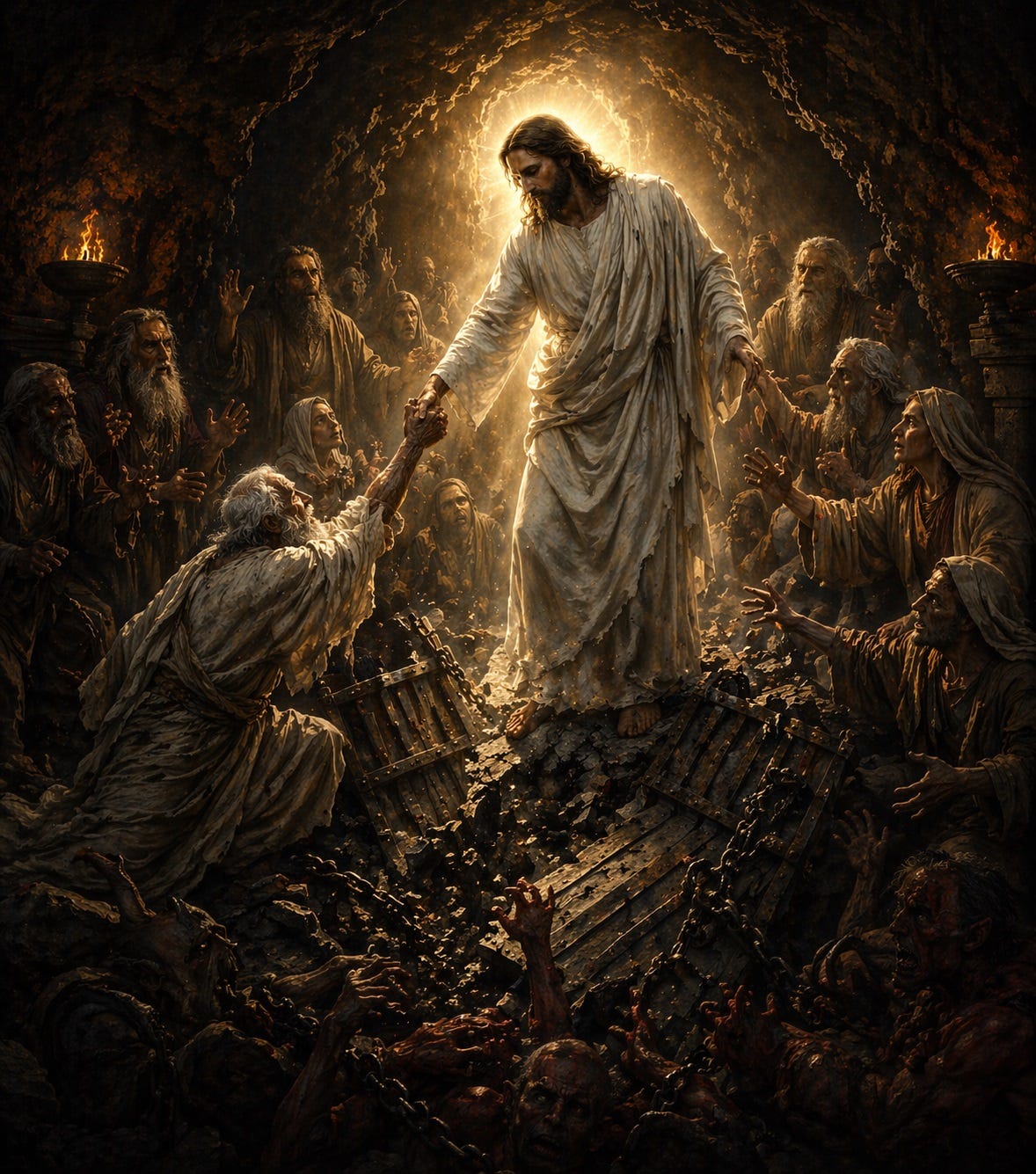
“And Jesus cried out again with a loud voice, and gave up His spirit. And behold, the veil of the temple was torn in two from top to bottom; and the earth shook and the rocks were split. Also the tombs were opened, and many bodies of the saints who had fallen asleep were raised; and coming out of the tombs after His resurrection, they entered the holy city and appeared to many.”
Matthew 27:50-53
These following excerpts from the apocryphal Gospel of Nicodemus tells us of two men—identified as the sons of the aged Simeon—who had died and were buried, yet were then found alive after Christ’s crucifixion, and they were dwelling together in prayer. Their tombs were discovered open, and word spread quickly that they had risen.
“And now hearken unto me; for we all know the blessed Simeon, the high priest which received the child Jesus in his hands in the temple. And this Simeon had two sons, brothers in blood and we all were at their falling asleep and at their burial. Go therefore and look upon their sepulchres: for they are open, because they have risen, and behold they are in the city of Arimathaea dwelling together in prayer. And indeed men hear them crying out, yet they speak with no man, but are silent as dead men. But come, let us go unto them and with all honour and gentleness bring them unto us, and if we adjure them, perchance they will tell us concerning the mystery of their rising again.”
While in a previous article about this we read that Emmerich’s account only made mention of Simeon’s sons being at the Temple, here we are able to track these two dead men as having emerged from their tombs in Arimathea. They “cry out” about things, not to anyone in particular, but for everyone in their vicinity to hear.
“When they heard these things, they all rejoiced. And Annas and Caiaphas, Nicodemus and Joseph and Gamaliel went and found them not in their sepulchre, but they went unto the city of Arimathaea, and found them there, kneeling on their knees and giving themselves unto prayer. And they kissed them, and with all reverence and in the fear of God they brought them to Jerusalem into the synagogue. And they shut the doors and took the law of the Lord and put it into their hands, and adjured them by the God Adonai and the God of Israel which spake unto our fathers by the prophets, saying: Believe ye that it is Jesus which raised you from the dead? Tell us how ye have arisen from the dead.”
In Emmerich’s account, which we discussed before, Annas and Caiaphas behaved indifferently to the presence of the two resurrected men, and they tried to carry on with the Temple sacrifice. But here, we find the two high priests actively investigating Simeon’s ghost-sons. Their first instinct? Drag them into a synagogue in Jerusalem and put the Torah in their post-dead hands.
Furthermore, these High Priests are “adjuring” them—that is, commanding the ghost-sons to swear, sort of like swearing by the Bible or “swearing on my mother’s grave.” But they’re told to not just swear to the God of Israel, but also to this “Adonai.” And who or what is that? “Adonai” is a Hebrew word meaning “Lord” or “My Lord.” So that sentence is saying that they want the two ghost-sons to swear an oath to “My Lord, the God of Israel.”
“And when Karinus and Leucius heard this adjuration, they trembled in their body and groaned, being troubled in heart. And looking up together unto heaven they made the seal of the cross with their fingers upon their tongues, and forthwith they spake both of them, saying: Give us each a volume of paper, and let us write that which we have seen and heard. And they gave them unto them, and each of them sat down and wrote…”
Simeon’s sons are named here, they appear to be speaking in unison, and they are physically writing something down. (I wonder if these penned documents are still physically in existence anywhere, provided that this “gospel” is true.)
“O Lord Jesu Christ, the life and resurrection of the dead (al. resurrection of the dead and the life of the living), suffer us to speak of the mysteries of thy majesty which thou didst perform after thy death upon the cross, inasmuch as we have been adjured by thy Name. For thou didst command us thy servants to tell no man the secrets of thy divine majesty which thou wroughtest in hell.
“Now when we were set together with all our fathers in the deep, in obscurity of darkness, on a sudden there came a golden heat of the sun and a purple and royal light shining upon us. And immediately the father of the whole race of men, together with all the patriarchs and prophets, rejoiced, saying: This light is the beginning (author) of everlasting light which did promise to send unto us his co-eternal light. And Esaias cried out and said: This is the light of the Father, even the Son of God, according as I prophesied when I lived upon the earth: The land of Zabulon and the land of Nephthalim beyond Jordan, of Galilee of the Gentiles, the people that walked in darkness have seen a great light, and they that dwell in the land of the shadow of death, upon them did the light shine. And now hath it come and shone upon us that sit in death.”
So previously, Simeon’s sons were commanded not to reveal any of Christ’s secret events in the land of the dead. But now having sworn to God—there in that synagogue—swearing that they would tell the High Priests what happened, they then were compelled by oath to testify as to what happened in the underworld.
And so, there in the depths of the dark world of the afterlife, Christ came upon the souls of the dead in a gold and purple light. And everyone knew it was Him. And Isaiah (long-since dead, also there in death’s abode) feels affirmed and vindicated, proclaiming that his vision has come true, and the Son of God was triumphant in His mission.
“And as we all rejoiced in the light which shined upon us, there came unto us our father Simeon, and he rejoicing said unto us: Glorify ye the Lord Jesus Christ, the Son of God; for I received him in my hands in the temple when he was born a child, and being moved of the Holy Ghost I made confession and said unto him: Now have mine eyes seen thy salvation which thou hast prepared before the face of all people, a light to lighten the Gentiles, and to be the glory of thy people Israel. And when they heard these things, the whole multitude of the saints rejoiced yet more.”
Here, the two ghost-sons talk about a moment when their father, also dead, comes to them and rejoices about seeing Jesus. Simeon was still a living old man when he saw Jesus. And of course, Jesus was a baby back then. So this is quite a reunion. Simeon is seeing the small baby all grown up into a man, and that man is triumphant even over death.
After that, John the Baptist appears from among the dead and proclaims that Christ has come to save those in darkness, confirming His divine identity and mission. Adam then recalls a prophecy given to his son, Seth, that in the fullness of time, the Son of God would come, be baptized, and ultimately descend to raise the dead and restore Adam himself to Paradise.
Then, as the patriarchs and prophets rejoice at this long-awaited fulfillment, the scene shifts to tension, as Satan warns Hell to prepare for Christ’s arrival, recognizing Him as a powerful adversary who has already begun to undo death’s dominion. But then, the land of the dead speaks with a voice of its own! And Hell complains to Satan:
“Hell answered and said: Thou hast told me that it is He that hath taken away dead men from me. For there be many which while they lived on the earth have taken dead men from me, yet not by their own power but by prayer to God, and their Almighty God hath taken them from me. Who is this Jesus which by His own word without prayer hath drawn dead men from me? Perchance it is He which by the word of His command did restore to life Lazarus which was four days dead and stank and was corrupt, whom I held here dead.”
Hell is personified. It speaks and reasons. Rather than being defiant, Hell is afraid. Hell recals the raising of Lazarus and realizes that was a newly-set precedent. This is crucial, as Lazarus was taken without any negotiation or bargaining. That single act becomes the basis for Hell’s terror.
Hell recognizes that Christ isn’t operating as a petitioner. He does not pray to God to release the dead. He commands. The prophets, the saints, miracle-workers of old—when they raised the dead, they did so through supplication. Christ does so through authority.
So when Hell says, “Who is this Jesus which by His own word…?”—it is not rhetorical. It is recognition of a category-breaking presence. This is not a man entering the underworld, but The Owner entering occupied territory.
“Satan the prince of death answered and said: It is that same Jesus.
”When Hell heard that, he said unto him: I adjure thee by thy strength and mine own that thou bring Him not unto me. For at that time I, when I heard the command of His word, did quake and was overwhelmed with fear, and all my ministries with me were troubled. Neither could we keep Lazarus, but He like an Eagle shaking Himself, leaped forth with all agility and swiftness, and departed from us, and the Earth also which held the dead body of Lazarus straightway gave him up alive. Wherefore now I know that that man which was able to do these things is a God strong in command and mighty in manhood, and that He is the savior of mankind. And if thou bring Him unto me, He will set free all that are here shut up in the hard prison and bound in the chains of their sins that cannot be broken, and will bring them unto the life of His Godhead for ever.“Thou that didst lie dead in the sepulchre hast come down unto us living and at thy death all creation quaked and all the stars were shaken and thou hast become free among the dead and dost rout our legions. Who art thou that settest free the prisoners that are held bound by original sin and restorest them into their former liberty? Who art thou that sheddest thy divine and bright light upon them that were blinded with the darkness of their sins? After the same manner all the legions of devils were stricken with like fear and cried out all together in the terror of their confusion, saying: Whence art thou, Jesus, a man so mighty and bright in majesty, so excellent without spot and clean from sin? For that world of earth which hath been always subject unto us until now, and did pay tribute to our profit, hath never sent unto us a dead man like thee, nor ever dispatched such a gift unto Hell. Who then art thou that so fearlessly enterest our borders, and not only fearest not our torments, but besides essayest to bear away all men out of our bonds?”
The language here escalates, and rightly so. What began as fear becomes panic. Hell is no longer questioning. Instead, Hell pleads with Satan: Don’t bring Him here! Hell, was holding all of mankind in its bondage. But now, Hell warns its own prince that this god-man—this Jesus—is an existential threat. Christ undoes the very logic of damnation by liberating people.
Also, the description of Lazarus “leaping forth…like an Eagle” is not accidental. It’s meant to evoke something violent, sudden, and unstoppable. Because in his case, at least, resurrection was more of a breach than a gentle awakening. And now, with Christ, that breach is about to happen on a cosmic scale.
What’s more, demons themselves bear witness to all this. Their question—“Who art thou?”—echoes across multiple Gospel accounts. It is the question of beings who recognize authority but they’re unable to categorize it. They see purity, power, and an absence of sin, and this terrifies them more than anything else. Sin was the mechanism by which Hell held dominion. But there stood a man without sin.
So the entire structure collapsed at that moment.
These are the divine and holy mysteries which we saw and heard, even I, Karinus, and Leucius: but we were not suffered to relate further the rest of the mysteries of God, according as Michael the archangel strictly charged us, saying: Ye shall go with your brethren unto Jerusalem and remain in prayer, crying out and glorifying the resurrection of the Lord Jesus Christ, who hath raised you from the dead together with him: and ye shall not be speaking with any man, but sit as dumb men, until the hour come when the Lord himself suffereth you to declare the mysteries of his god head. But unto us Michael the archangel gave commandment that we should go over Jordan unto a place rich and fertile, where are many which rose again together with us for a testimony of the resurrection of Christ the Lord. For three days only were allowed unto us who rose from the dead, to keep the passover of the Lord in Jerusalem with our kindred (parents) that are living for a testimony of the resurrection of Christ the Lord: and we were baptized in the holy river of Jordan and received white robes, every one of us. And after the three days, when we had kept the passover of the Lord, all they were caught up in the clouds which had risen again with us, and were taken over Jordan and were no more seen of any man. But unto us it was said that we should remain in the city of Arimathaea and continue in prayer.
This final portion, I find, to be very interesting. These two resurrected men, Karinus and Leucius, were not permitted to remain in Jerusalem. They testified briefly, they wrote confirmed what they saw. And then, they were “removed.” They’re given white robes and “taken beyond the Jordan,” never to be seen again on this Earth.
This was not a resurrection as we typically would imagine it. Their visit was a temporary testimony. They are raised not to resume life, but to bear witness and function as living evidence. And then, just as suddenly, they were withdrawn from the world.
Also, note the constraint placed upon them: silence. Even after seeing the harrowing of Hell and Christ’s triumph over death, they weren’t free to speak at will. Their knowledge was regulated and governed. This ultimately suggests that not all revelation is meant for immediate or universal distribution. Mysteries are shown, recorded, and then deliberately veiled again.
(Perhaps something to consider when gleaning data from demons during exorcisms. A side thought I just had.)
Conclusion
At minimum, we are forced to confront the strangeness embedded in the Passion narrative itself. The Gospel of Matthew gives us only the barest outline. We see opened tombs and raised saints. It is a shocking detail that casually mentioned, unelaborated, and forgotten by everyone I know. Most people don’t even know that bible verse exists. But for me, anyway, that very silence invites deeper inquiry.
The Gospel of Nicodemus presents a Christ who descends as a conqueror. He doesn’t negotiate with Death. Instead, He invades Death. The Underworld became destabilized, fearful, and even argumentative in the face of a power it couldn’t contain.
Whether one accepts every detail of this apocryphal account is almost beside the point. I feel that the central claim remains consistent with the broader Christian claim. In His death, Christ didn’t merely die—He acted. He entered the domain of Death, broke it open from within, and undid its claim over mankind.
And if even a fraction of these testimonies are true—if the dead truly rose, walked, spoke, and then vanished—then the Resurrection was acting more like an outbreak that ruptured the normal order of the ancient world. For a brief moment, the boundary between the living and the dead gave way, and the consequences spilled into the world of men.
It really sounds like a positive version of a zombie movie.
The witnesses themselves did not remain. They appeared, testified, and were taken. Not restored to ordinary life, but they were deliberately used as signs. Their brief presence suggested that the Resurrection was meant to be attested to in the most miraculous way.
It is also central to the necessity of salvation that the dead had to rise, in order to be Baptized, before they could enter the Kingdom of Heaven. This reality necessarily points to the urgency of affirming the dogma in our day, "Extra Ecclesiam nulla salus" - "Outside the Church there is no salvation."
KHRYSTOS VOSKRESE, bro!
Fascinating!! Thank you!
Leaving for Divine Liturgy soon.
Our Lady of Guadalupe watch over you!